
When Shepherding Hurts
There are seasons in pastoral ministry when shepherding hurts.
I don't mean the ordinary frustrations of church work—the meeting that runs too long, the program that doesn't work, the criticism that comes with leadership, or the thousand small inconveniences that pastors learn to take in stride. I mean those seasons when something about the ministry itself wounds the shepherd.
You still love the people. You still believe the gospel. You still climb into the pulpit and discover, sometimes to your own surprise, that the Word of God is as alive as it ever was. You preach. You pray. You visit. You bury the dead. You listen to the frightened. You encourage the discouraged. And the Holy Spirit remains wonderfully faithful.
Then you go home.
And you discover that you are tired.
Maybe hurt.
Maybe angry.
Maybe disappointed by people you trusted.
Maybe simply sad.
There is a peculiar temptation in such seasons to believe that faithful shepherds aren't supposed to feel these things. We have spent so much of our lives being the steady presence in someone else's storm that we can become embarrassed when the storm is ours.
But shepherds are sheep, too.
That is something I am learning again.
I have been preaching through Job recently, and one of the gifts of Job is his refusal to pretend. Job does not protect God with pious dishonesty. He does not call agony "joy" because he thinks that is what a faithful man is supposed to say. He brings the whole bewildering mess into the presence of God.
And God does not abandon him there.
There is grace in that for pastors.
Sometimes faithfulness means getting up and doing the work when the heart is light. Sometimes it means doing the same work when the heart is heavy. And sometimes, after doing it, faithfulness means admitting that it cost you something.
That isn't failure. It is incarnation.
Jesus never asked us to become less human in order to shepherd his people.
There is another lesson I am learning, too, and perhaps it is the harder one: a shepherd cannot control every story being told about him.
Pastors can explain. We can clarify. We can apologize when we are wrong. We can correct what genuinely needs correcting. We can establish healthy boundaries and insist upon honest processes. All of that may be necessary.
But eventually we encounter the limit of our own ability to make another person see us correctly.
That is an uncomfortable place for anyone. It is especially uncomfortable for pastors because trust is part of the currency of our vocation. When our motives are misunderstood, the instinct to defend ourselves can become nearly irresistible.
There comes a point, however, when vindication itself can become an idol.
Jesus knew what it was to be misunderstood. Paul knew it. Moses knew it. Every shepherd who serves long enough will eventually know something of it.
The question then becomes not, "How do I make everyone understand me?"
The better question is, "How do I remain faithful while I am not understood?"
I am increasingly convinced that the answer is remarkably ordinary.
Tell the truth.
Own what is yours.
Refuse what is not.
Keep appropriate boundaries.
Do the next faithful thing.
Love people without requiring them to vindicate you.
And entrust your reputation to God.
None of that means becoming passive in the face of wrongdoing. Shepherds have a responsibility to protect the flock, exercise authority faithfully, and confront what needs confronting. But there is a great difference between exercising responsibility and demanding vindication.
I can do the first.
The second belongs to God.
Perhaps that is one of the freedoms hidden inside painful seasons of ministry. We remember whose church this actually is.
The sheep belong to Jesus.
The difficult sheep belong to Jesus.
The people who love the shepherd belong to Jesus.
The people who misunderstand the shepherd belong to Jesus.
And, thank God, the shepherd belongs to Jesus, too.
So, brother or sister shepherd, if this happens to be a season when shepherding hurts, you do not have to pretend otherwise.
You don't have to solve the whole future today.
You don't have to win every argument.
You don't even have to feel particularly courageous.
Stay near Jesus.
Tell the truth.
Do the work he has actually given you to do today.
And when the day's shepherding is finished, remember that you are allowed to come home tired.
The Chief Shepherd is still on duty.
Carrying Authority Without Urgency
By Dan Sinkhorn
There is a subtle danger that confronts nearly every pastor, though few seminaries prepare us for it and few conferences address it directly.
It is the danger of urgency.
Not the occasional urgency of responding to a crisis. Ministry will always require that. Hospitals call in the middle of the night. Families grieve unexpectedly. Congregations sometimes face moments that demand immediate attention.
Those are not the urgencies that concern me.
I am speaking of the quieter kind—the persistent feeling that everything is pressing, every decision is critical, every email deserves an immediate reply, every conflict must be settled today, every opportunity must be seized before it disappears.
When urgency becomes our normal pace, it slowly begins to shape our souls.
For years I mistook urgency for faithfulness. If I worked harder, answered faster, attended one more meeting, solved one more problem, surely I was being a good shepherd.
Eventually I began to notice something.
The more hurried I became, the less discerning I was.
My decisions were not necessarily wrong, but they were increasingly reactive. I found myself solving today's problem while unintentionally creating tomorrow's.
That realization forced me back to the Gospels.
Jesus never appeared rushed.
Crowds demanded Him.
Disciples misunderstood Him.
Religious leaders opposed Him.
People interrupted Him constantly.
Yet there is a remarkable steadiness in the life of Christ.
He moved with purpose but without panic.
He never confused someone else's urgency with the Father's timing.
That observation has become deeply convicting to me.
Pastoral authority does not grow from perpetual motion.
It grows from abiding.
The New Testament consistently places character before competency, being before doing, communion before commission.
Our culture often reverses that order. Churches sometimes do as well.
We admire the busiest pastor, the most accessible leader, the one whose calendar never has a blank space.
But activity is not the same as fruitfulness.
In fact, excessive activity can become a way of avoiding the deeper work God wants to accomplish within us.
I've also discovered something else.
Congregations tend to borrow the emotional pace of their leaders.
An anxious pastor rarely produces a peaceful church.
A reactive leader often creates a reactive culture.
Conversely, when a pastor learns to remain prayerful in conflict, patient in uncertainty, and hopeful during seasons of change, something remarkable begins to happen. That steadiness gradually becomes part of the congregation's culture as well.
People begin to trust not merely the pastor's decisions, but the pastor's presence.
I write this as someone still learning.
There are days when I still confuse movement with progress.
There are weeks when the calendar seems to dictate my soul more than Scripture does.
But after decades of ministry, I have become convinced that one of the greatest gifts a pastor can offer a congregation is not constant availability, flawless leadership, or endless productivity.
It is a settled spirit.
The kind of spirit that has learned to wait on God before reacting.
The kind of heart that believes Christ is still Lord of His Church even when circumstances suggest otherwise.
The kind of leader who can stand in the middle of conflict without becoming defined by it.
Perhaps this is one of the quiet works of the Holy Spirit in those who shepherd God's people.
Not making us faster.
Not making us busier.
Making us steadier.
The Church has never needed frantic shepherds.
It has always needed faithful ones.
And faithfulness, I've come to believe, is rarely hurried.
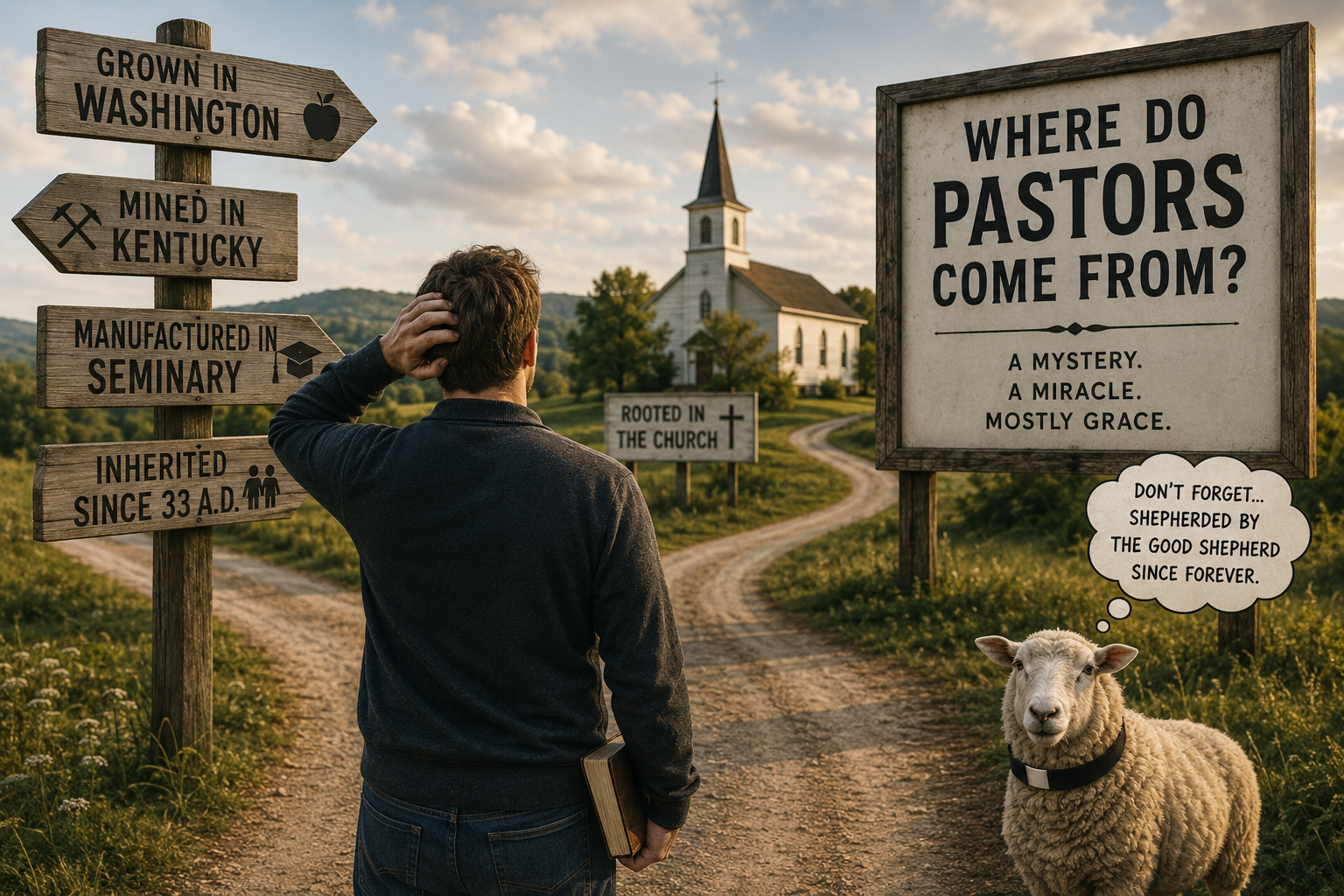
Where Do Pastors Come From?
Where do pastors actually come from? Seminaries? Church families? Some mysterious clergy assembly line hidden deep in the hills of Kentucky? With warmth, humor, and honesty, Where Do Pastors Come From? traces one pastor’s journey through Catholic roots, Methodist influence, spiritual wandering, quiet recognition, and the long, patient work of God’s calling. More than a story about ministry, it is a reflection on how churches help people hear the voice of God over time.
A Story of Calling, Recognition, and the Long Work of God
I’ve been asked a lot of questions over the years as a pastor. Some are theological. Some are practical. Some are deeply personal. But there’s one question that people almost never ask out loud, even though I suspect many have wondered it:
Where do pastors actually come from?
Do they grow somewhere?
Are there orchards in Washington State where, under the right conditions, pastors begin to sprout like apple blossoms — subtle at first, then increasingly noticeable until, by late summer, they’re fully formed, slightly awkward, and ready for harvest?
Or maybe they’re mined out of the hills of Kentucky. Deep underground, teams of seasoned clergy descending into the earth with lanterns in hand, calling back up to the surface:
“We’ve struck a vein of youth pastors. Send down more coffee.”
Or perhaps they’re manufactured. A perfectly ordinary college student goes into seminary — undecided, mildly anxious about the future — and after a few years of Greek, theology, and caffeine, out comes a pastor. Fully credentialed. Slightly sleep-deprived. Ready to preach.
Some people actually believe something like that. Ministry as Plan B. The place you end up when Plan A didn’t quite come together.
And then there’s another theory — one I’ve observed often enough to smile at it. Maybe pastors are simply inherited.
You ever notice how many of them are named John, Charles, Wesley…?
You begin to wonder if somewhere along the way a quiet agreement was made:
“Let’s just keep this going through the family line.”
To be fair, sometimes it does look that way.
But if I’m honest — if I strip away the humor and assumptions — none of those explanations really answers the question.
Because when I ask, “Where do pastors come from?” I don’t think about orchards or seminaries or family trees.
I think about a little boy in a Roman Catholic church.
A Boy at the Altar
I grew up in the Roman Catholic Church. I was an altar boy throughout my childhood and teenage years. I rang the bells. I assisted with the Mass. I learned the rhythms and rituals of something ancient and holy.
But more than that, I was aware.
Sensitive, even as a child, to something I couldn’t fully explain. There was a sense of the divine hovering just beyond my understanding, but not beyond my perception.
I asked questions — lots of them. The kind that don’t always fit neatly into liturgy or catechism. I asked priests detailed things as we prepared for and completed the Mass. I read the only Bible our family had, often lingering over the pictures, trying to understand the stories behind them.
I spent long stretches of time alone — in the woods, at a hobby bench, thinking, wondering, tinkering.
By most social measures, I was a bit awkward. Maybe more than a bit. I relied heavily on a very small number of authentic friendships where I could be myself without explanation.
And in all of that, God was there.
I didn’t know it at the time, but He was already calling.
A Stranger in a New Land
When I was sixteen, we moved to Oklahoma — a mall Bible Belt town that might as well have been another country.
Suddenly I was surrounded by Protestants.
Not just people who went to church, but people who talked about faith in ways that were new, confident, and often directed at me.
To them, I was something of a curiosity. A Catholic. From “the East.” A theological foreigner.
I began attending Wednesday night services. I listened to arguments against Catholicism. I heard carefully constructed presentations of the Gospel — sincere, well-meaning, but often spiritually immature.
If I’m honest, I probably got “saved” a couple of times.
Mostly so the girl who brought me to the altar could tell her parents it was okay to go on a date with me.
At the time, I didn’t fully understand what I was doing. I thought maybe I was praying for the weather or something. Covering all the bases.
But underneath all of that, I was attentive. I was prayerful. I was listening.
I was introduced to contemporary Christian music and spent hours absorbing it. Something new began forming inside me — not a rejection of what I had known, but an expansion of it.
God was still there.
Still calling.
Resistance and the Long Road Back
At one point, my father became convinced I should become a priest.
I considered it.
For about five minutes.
The more he wanted it, the less I did. Not because the calling wasn’t real, but because the pressure behind it pushed me away. By that point, my faith had also taken on another dimension: truth-seeking. There were aspects of Catholic tradition I could not fully reconcile. Questions I could not simply set aside.
As I finished high school, I struggled to find myself. I rebelled, experimented, drifted.
Church and Christian things went on hiatus for long stretches.
But I always found my way back.
Even my rebellion had limits. My nature — straight arrow at its core — never fully abandoned me. Still, I was not yet living with clarity or direction.
Love, Roots, and the Slow Work of Formation
Like many young men, my hopes centered around finding a wife, building a life, and becoming independent.
I married a Methodist girl from my graduating class. Through her family, I encountered something that felt both unfamiliar and strangely recognizable at the same time.
They were deeply rooted in their church.
Not merely attendees. Their Methodist congregation shaped family rhythms, relationships, social life, identity, traditions, holidays, friendships, and loyalties. Church dinners, gatherings, customs, and expectations all flowed naturally from that shared congregational life together. In many ways, they were every bit as formed by their Methodist world as my own family had been formed by Roman Catholicism.
That made an impression on me.
Much of what I had encountered in broader Protestant culture up to that point had felt fragmented, reactive, or disconnected from rooted identity and history. But through marriage and family integration, I was no longer observing Methodism from a distance or through theological debate. I was living close enough to see another Christian tradition from the inside.
I saw ordinary people sincerely shaped by inherited faith, congregational life, and longstanding religious culture.
I did not fully understand it at the time, but those experiences quietly broadened my understanding of the Church itself.
We eventually moved back to southern Indiana — my birthplace — and spent several years trying to build a life together as many young couples do: sincerely, imperfectly, and with more optimism than wisdom. In time, the marriage ended painfully, and life entered a difficult and disorienting season.
But even there, God had not disappeared.
Not dramatically.
Not all at once.
But steadily — and often painfully — He continued His work.
It felt something like stepping into the world described in The Great Divorce — a reality more solid than the one I had been living in. Light no longer merely illuminated things; it exposed them. My identity, misshapen by confusion and brokenness, slowly began to be rebuilt.
Redemption and Recognition
In time, God redeemed even the choices that had emerged from brokenness.
Laura came into my life, along with her son. We became a family.
Parenthood changed everything.
I wanted to be a good father.
I knew that meant becoming a good husband.
I knew that meant becoming a different man.
We began attending a Methodist church. Over time, through spiritual guidance, pastoral care, and community life, God continued His work.
Eventually, a pastor in Corydon, Indiana, asked me a question I could no longer ignore:
“Do you ever think God might be calling you into ministry?”
He wasn’t the first person to ask it.
But he was the one I could no longer dismiss.
Each time I heard that question, something in me recognized it before I was ready to admit it.
The Moment
I remember sitting in our rural driveway one night.
It was quiet. Still.
I had been praying day and night for clarity.
And then, across the sky, a comet blazed overhead.
The next morning, before dawn, a gust of wind blew open the storm door at our kitchen. I stepped out onto the porch.
The world was dark. The stars stretched overhead.
And I asked aloud:
“God… are You calling me?”
The wind stopped.
Instantly.
Now, I don’t build my theology on comets and wind.
But I do know this:
God had been calling me for a very long time.
Where Pastors Really Come From
So where do pastors come from?
Not from orchards.
Not from mines.
Not from factories.
Not even primarily from seminaries.
They come from moments like that.
But more than that, they come from everything leading up to those moments:
A child sensing something holy.
A church shaping early awareness.
Questions allowed to linger.
Confusion that never fully extinguishes curiosity.
People who notice.
People who ask.
People willing to say:
“That might be God. Go back and listen.”
Pastors do not come from nowhere.
They come from communities that know how to recognize calling.
The Deeper Truth
But this is not only about pastors.
It is about how God works.
God calls people.
And He almost always does it through other people.
The story of Samuel makes this clear. Samuel heard the voice of God, but he did not recognize it. It took Eli to say:
“That’s Him.”
Calling is rarely self-contained.
It is recognized, affirmed, and nurtured in community.
The Real Question
So the real question is not:
“Where do pastors come from?”
The real question is:
Who is God trying to call that might be waiting for someone to notice?
Because every time you say:
“I see something in you.”
“Have you ever prayed about that?”
“I think God may be doing something in your life…”
You are stepping into that sacred process yourself.
A Final Word
Calling is not always obvious.
It is often slow.
Sometimes resisted.
Sometimes misunderstood.
But God is patient.
And He keeps calling.
The question is not whether God is calling.
The question is whether we will become the kind of people — and the kind of church — that helps one another hear Him.
That’s where this pastor came from.
And that’s where the next ones will come from, too.
The Local Church as Mission Field
One of the most important lessons my congregation learned during my renewal leave was this: Christ is capable of shepherding His church while the pastor rests.
Before my leave began, we spent months preparing carefully. Roles were clarified. Responsibilities were shared. Expectations were communicated. We trusted that years of discipleship and leadership development had actually produced something real within the congregation.
And it had.
The church continued worshiping.
People continued serving.
Ministry continued unfolding.
God continued working.
Renewal leave is not abandonment of ministry. At its best, it becomes an act of long-term stewardship — reminding both pastors and congregations that the church belongs to Christ before it belongs to any pastor, personality, or institution.
Sometimes the healthiest thing a church can do is lovingly allow its shepherd to become quiet long enough to hear God again.
Why Pastors Must Continually Re-Evangelize the Church
In recent days our church hosted another major event centered around recovery, surrender, salvation, and the transforming grace of Christ. It was a powerful evening. People responded sincerely. Testimonies were shared. Hope was visible.
At one point, the guest speaker made several comments about churches and church culture that, broadly speaking, were not entirely untrue. Most pastors who have served for any length of time understand exactly what he meant. Churches can become insulated. Comfortable. Program-driven. Socially predictable. Spiritually sleepy.
And yet, sitting there listening, I felt an internal tension rise within me.
Not anger.
Not defensiveness.
Something more reflective.
Because for most of my pastoral life, I have quietly understood my calling somewhat differently than many people realize. I have increasingly come to see myself not merely as the shepherd of a congregation, but as a missionary to people already sitting in pews.
That statement may sound strange at first, but I suspect many experienced pastors understand it immediately.
The local church is not a static thing. It is never fully formed. It is always drifting somewhere.
Without continual spiritual renewal, churches naturally drift toward familiarity, social equilibrium, institutional maintenance, nostalgia, and forms of comfortable Christianity that slowly replace genuine discipleship. This is not because church people are uniquely evil. It is because human beings naturally settle into patterns that reduce tension, preserve stability, and protect familiar identities.
This is one reason I have always appreciated many of the observations made by my friend Frank Viola regarding the drift of the modern church away from apostolic simplicity and spiritual vitality. Frank has sometimes developed a reputation for being anti-institutional, but I have never understood his deeper concern that way. His critique, as I understand it, is not hatred for the Church, but grief over how easily Christian movements drift from the living heart of Christ-centered community into systems that eventually prioritize self-preservation.
That concern resonates with me deeply.
At the same time, however, I have spent decades serving inside the local church and trying patiently to help real congregations move toward healthier, more apostolic life without despising the people already there.
That work is slow.
Sometimes painfully slow.
And unlike revival ministries or conference platforms, local church ministry requires living among people through the long middle of transformation.
A traveling evangelist may encounter people at moments of crisis and openness. A local pastor walks with them afterward:
when enthusiasm fades,
when conflict emerges,
when old habits return,
when spiritual growth slows,
when comfort settles back in,
when discipleship becomes ordinary rather than dramatic.
That is harder work than many people realize.
One of the unintended consequences of modern testimony culture is that dramatic conversion stories sometimes become the unspoken standard by which all spirituality is measured. The person radically delivered from addiction or rescued from visible destruction is celebrated — and rightly so. God’s transforming grace is glorious.
But there is another kind of testimony that matters deeply too.
There is the believer who slowly learned faithfulness over fifty years.
The woman who quietly raised children in the faith.
The ordinary Christian who matured gradually through worship, prayer, repentance, Scripture, suffering, sacraments, and long obedience.
Yet many lifelong church members quietly feel spiritually incomplete because their story is not dramatic enough.
That troubles me.
Scripture honors both Paul on the Damascus road and Timothy raised from childhood in the Scriptures. The Kingdom of God has room for both sudden rescue and slow formation.
In fact, the local church may be one of the only remaining places in modern society where slow human formation is still possible over generations.
But that process is tedious compared to revival culture. It lacks spectacle. It often feels repetitive. It requires patience, structure, endurance, forgiveness, and long-term relationships.
In many ways, it resembles Israel in the wilderness far more than a mountaintop revival meeting.
I sometimes think pastors discover that the hardest part of ministry is not leading people out of Egypt, but walking patiently beside them while Egypt slowly leaves them.
People often leave bondage physically long before they leave it psychologically.
Congregations may embrace salvation while still resisting surrender.
They may desire renewal while instinctively defending comfort.
They may pray for growth while resisting the very changes growth requires.
And pastors live inside that tension for decades.
This is why I increasingly resist simplistic attacks on “institutional churches.” The institution is not the enemy. Without institutions there would be no continuity of doctrine, no preserved theological tradition, no long-term mission structures, no seminaries, no accountability systems, no sacraments faithfully stewarded across generations.
And yet institutions themselves are never the point.
That tension matters deeply to me right now as part of the emerging Global Methodist Church following the painful divisions within the United Methodist Church.
One of my quiet concerns is that we may fail to fully seize the opportunity before us. After surviving denominational conflict, it is understandable that leaders become focused on stabilization, structure, protection, and continuity. Those things matter. They truly do.
But every renewal movement eventually faces the same temptation:
to slowly begin protecting the institution more than the spiritual life the institution was created to serve.
That danger is not unique to Methodists. It is part of nearly every movement in church history. Revivals institutionalize. Reform movements stabilize. Structures become self-protective. Human beings drift.
Which means the work of renewal is never finished.
The local church remains both beautiful and unfinished.
The institution remains both necessary and vulnerable.
The people in the pews remain both sincere and partially formed.
And pastors remain called to love them patiently anyway.
That, perhaps, is one of the most missionary tasks imaginable.
Not abandoning the Church.
Not romanticizing the Church.
Not despising the Church.
But loving her enough to continually call her back toward Christ.
The Church That Learned to Let Its Pastor Rest
One of the unexpected discoveries of my pastoral renewal leave was that the experience was shaping not only me, but the church itself.
Healthy churches often say they value their pastor’s well-being, yet many congregations quietly adapt to patterns that require continual emotional and spiritual output from their shepherds without recognizing the cumulative cost. Over time, both pastor and congregation can unintentionally normalize an unsustainable pace.
One of the most important lessons our church learned during my leave was this: Christ is capable of shepherding His church while the pastor rests.
The church continued worshiping.
People continued serving.
Ministry continued unfolding.
God continued working.
Renewal leave is not abandonment of ministry. At its best, it is an act of long-term stewardship — a reminder that both pastors and congregations must learn again that the church belongs to Christ before it belongs to any personality, structure, or leader.
Renewal Is Not Only for Shepherds
One of the unexpected discoveries of my pastoral renewal leave was that the experience was shaping not only me, but the church itself.
When most people think about pastoral renewal leave, they imagine a weary pastor stepping away in order to recover emotionally, spiritually, or physically. That certainly happened. I needed the rest more than I fully understood at the time.
But over the course of those months, I slowly realized something deeper was unfolding beneath the surface:
the church was also being invited into renewal.
That realization changed the way I now think about sabbaticals, renewal leaves, and long-term pastoral leadership altogether.
Healthy churches often say they value their pastor’s well-being. Most genuinely mean it. Yet many congregations quietly adapt to patterns that require continual emotional and spiritual output from their shepherds without fully recognizing the cumulative cost. Pastors cooperate with this dynamic more than we care to admit. We answer every text. Solve every problem. Carry every burden. Remain continually accessible. Over time both pastor and congregation can unintentionally normalize a pace that is sustainable for neither.
Eventually a church can begin functioning as though the pastor’s constant presence is the glue holding everything together.
That is not healthy for anyone.
One of the most important lessons my congregation learned during my leave was this:
Christ is capable of shepherding His church while the pastor rests.
That sounds obvious theologically, but many churches — and many pastors — live as though it is not entirely true.
Before my leave began, we spent months preparing carefully. Staff roles were clarified. Spiritual leadership responsibilities were reinforced. Boundaries were established. Expectations were communicated. We did not simply “leave things unattended.” We intentionally trusted that years of discipleship, leadership development, and spiritual formation had actually produced something real inside the congregation.
And it had.
The church continued worshiping.
People continued serving.
Ministry continued unfolding.
New people continued arriving.
God continued working.
Not perfectly.
Not without tensions.
But faithfully.
In fact, some of the very tensions that surfaced during and after my leave revealed important truths about the spiritual maturity of the congregation and leadership culture itself. Renewal has a way of exposing underlying assumptions. It reveals where identity, dependency, anxiety, and control may have quietly rooted themselves beneath the visible structure of church life.
In many ways, my renewal leave became a test of whether our church truly believed the things we preached.
Did we genuinely believe in shared ministry?
Did we genuinely believe the Holy Spirit empowers the whole body?
Did we genuinely believe discipleship produces mature believers rather than passive consumers?
Did we genuinely believe the church belongs to Christ?
Those questions matter more than many churches realize.
One of my growing concerns in modern ministry is that churches often speak enthusiastically about pastoral health while still quietly expecting pastors to function as perpetual spiritual first responders. Congregations may sincerely love their pastor while simultaneously building cultures that leave little room for the pastor to remain fully human.
That pattern eventually harms everyone.
Exhausted pastors become less patient.
Less prayerful.
Less emotionally resilient.
Less capable of deep listening.
Less internally grounded.
And churches slowly adapt to chronic low-level spiritual fatigue in their leadership as though it were normal.
It is not normal.
At least it should not be.
Renewal leave, at its best, is not abandonment of ministry. It is an act of long-term stewardship. It acknowledges that shepherds are finite human beings whose souls require rest, reflection, healing, and reconnection with God apart from continual ministry output.
But the deeper insight I carried home from my leave is this:
healthy pastoral renewal ultimately requires healthy congregational theology.
A church must learn to see its pastor not merely as a religious service provider, but as a fellow disciple, a finite human being, and a long-term steward whose endurance matters to the future health of the body itself.
And pastors, in turn, must relearn the humility of allowing the church to function without their constant intervention.
That may be one of the hardest lessons of all.
Many shepherds quietly carry the illusion that everything depends on them remaining continually vigilant. Letting go — even temporarily — can feel frightening, vulnerable, and irresponsible. Yet one of the most healing discoveries of my leave was realizing that Christ remained entirely capable of sustaining His church while I rested.
The church did not collapse.
The Kingdom did not pause.
The Holy Spirit did not become inactive.
In fact, the leave itself became part of the church’s discipleship.
Our congregation learned patience.
Shared responsibility.
Trust.
Adaptability.
Prayerfulness.
And perhaps most importantly, a deeper understanding that the church belongs to Christ before it belongs to any pastor, personality, or leadership structure.
I increasingly believe many churches do not merely need renewed pastors.
They need renewed expectations about what faithful pastoral life actually requires.
Because the goal is not merely surviving ministry.
The goal is sustaining healthy shepherding across decades of faithful service.
And sometimes the most spiritually mature thing a church can do is lovingly allow its pastor to become quiet long enough to hear God again.

When a Pastor Stays Still
One of the strangest discoveries of my pastoral renewal leave was realizing how difficult it had become for me to simply remain still.
Not lazy.
Not inactive.
Still.
For decades my life had been built around motion: sermons, meetings, crises, leadership pressures, emotional availability, and the constant invisible weight pastors quietly carry. Even rest had become productive.
My renewal leave slowly revealed something I had not fully understood: exhaustion is not always caused merely by overwork. Sometimes it comes from becoming disconnected from the quiet presence of God beneath the machinery of ministry.
Pastors often know how to preach surrender better than practice it.
Eventually the soul must relearn stillness — or risk forgetting how to hear God beneath the noise.
Reflections from a Renewal Leave
One of the strangest discoveries of my pastoral renewal leave was realizing how difficult it had become for me to simply remain still.
Not lazy.
Not inactive.
Still.
For decades my life had been built around motion:
sermons,
meetings,
phone calls,
hospital visits,
leadership crises,
vision casting,
emails,
emergencies,
planning,
problem solving,
constant emotional availability.
Even rest had quietly become productive.
Many pastors understand this without fully realizing it. Ministry can slowly condition a person to believe their worth is connected to usefulness. The shepherd becomes so accustomed to carrying responsibility that silence itself begins to feel vaguely irresponsible.
And then one day the soul grows tired in ways sleep alone cannot repair.
My renewal leave was never intended to be a vacation in the ordinary sense. I did not spend months chasing entertainment or attempting to escape ministry entirely. In many ways, the leave became something much older and more biblical than modern sabbatical culture often imagines.
It became a kind of wilderness.
Not punishment.
Not collapse.
Formation.
Like many pastors, I entered ministry because I genuinely loved Christ and loved people. Over time, however, the weight of leadership slowly layered itself over the simplicity of that original calling. Responsibilities multiplied. Institutional pressures accumulated. Expectations became normalized. Even healthy ministry rhythms could slowly crowd out interior stillness.
What surprised me most was not exhaustion itself.
It was how uncomfortable silence initially felt.
When external momentum slows, internal realities become louder.
Thoughts long deferred begin surfacing.
Grief becomes visible.
Anxiety no longer hides beneath productivity.
Identity questions emerge quietly in the background:
Who am I when I am not actively carrying everyone else?
What remains when usefulness is temporarily removed?
Can I still belong to God apart from visible ministry output?
Those are frightening questions for many pastors because ministry easily becomes intertwined with identity in ways we scarcely notice while actively serving.
I began to realize during my leave that much of pastoral life conditions leaders to live in a near-constant state of anticipatory awareness. Even during supposedly restful moments, part of the shepherd remains emotionally scanning:
Who is hurting?
What problem is emerging?
What conflict must be addressed?
What needs attention next?
Eventually the nervous system forgets how to fully exhale.
And yet Scripture repeatedly portrays God drawing His servants into wilderness seasons not merely to remove them from work, but to reintroduce them to dependence, silence, and presence.
Moses spent forty years in Midian before leading Israel.
Elijah encountered God not in spectacle, but in a gentle whisper.
Even Christ withdrew repeatedly from crowds in order to pray.
The modern church often celebrates visible ministry activity while quietly neglecting the interior life necessary to sustain it.
Pastors themselves frequently cooperate with this imbalance.
We know how to preach surrender better than practice it.
We know how to encourage rest better than receive it.
We know how to care for souls while neglecting our own.
And institutions, even healthy ones, can unintentionally reinforce this pattern. Churches naturally come to depend upon capable pastors. Capable pastors often struggle to admit limitations. Eventually both shepherd and congregation adapt to an unsustainable normal.
That realization became deeply important to me during my renewal leave.
I discovered that rest is not merely cessation of activity. True rest is relearning that God remains God while we are quiet.
That sounds obvious theologically.
It feels far more difficult emotionally.
There is a subtle but dangerous illusion hidden inside long-term ministry: the feeling that everything depends on us remaining continually engaged. Most pastors would deny believing this consciously, yet many of us quietly live as though the church cannot function unless we remain constantly vigilant.
One of the most healing aspects of my leave was discovering that Christ remained faithful to His church while I rested.
The church continued worshiping.
People continued growing.
Ministry continued unfolding.
God continued working.
That realization was both humbling and freeing.
It reminded me that pastors are shepherds, but never saviors.
In recent years there has been increasing discussion about burnout, mental health, and pastoral exhaustion. Those conversations matter greatly. But I sometimes wonder whether the deeper issue beneath many of those struggles is not merely overwork, but disconnection from the quiet presence of God beneath the machinery of ministry.
The soul was not designed to live perpetually accelerated.
Eventually pastors must relearn stillness or risk becoming strangers to their own interior life.
My renewal leave did not solve every problem. It did not magically remove all fatigue or permanently resolve every tension connected to ministry. What it did provide was something quieter and perhaps more valuable:
space to hear God again beneath the noise.
Not merely God’s direction for ministry.
God Himself.
That distinction matters more than many pastors realize.
Because in the end, the shepherd’s soul cannot survive indefinitely on ministry activity alone. Eventually we must rediscover the Christ who first called us before we learned how to carry the weight of serving Him publicly.
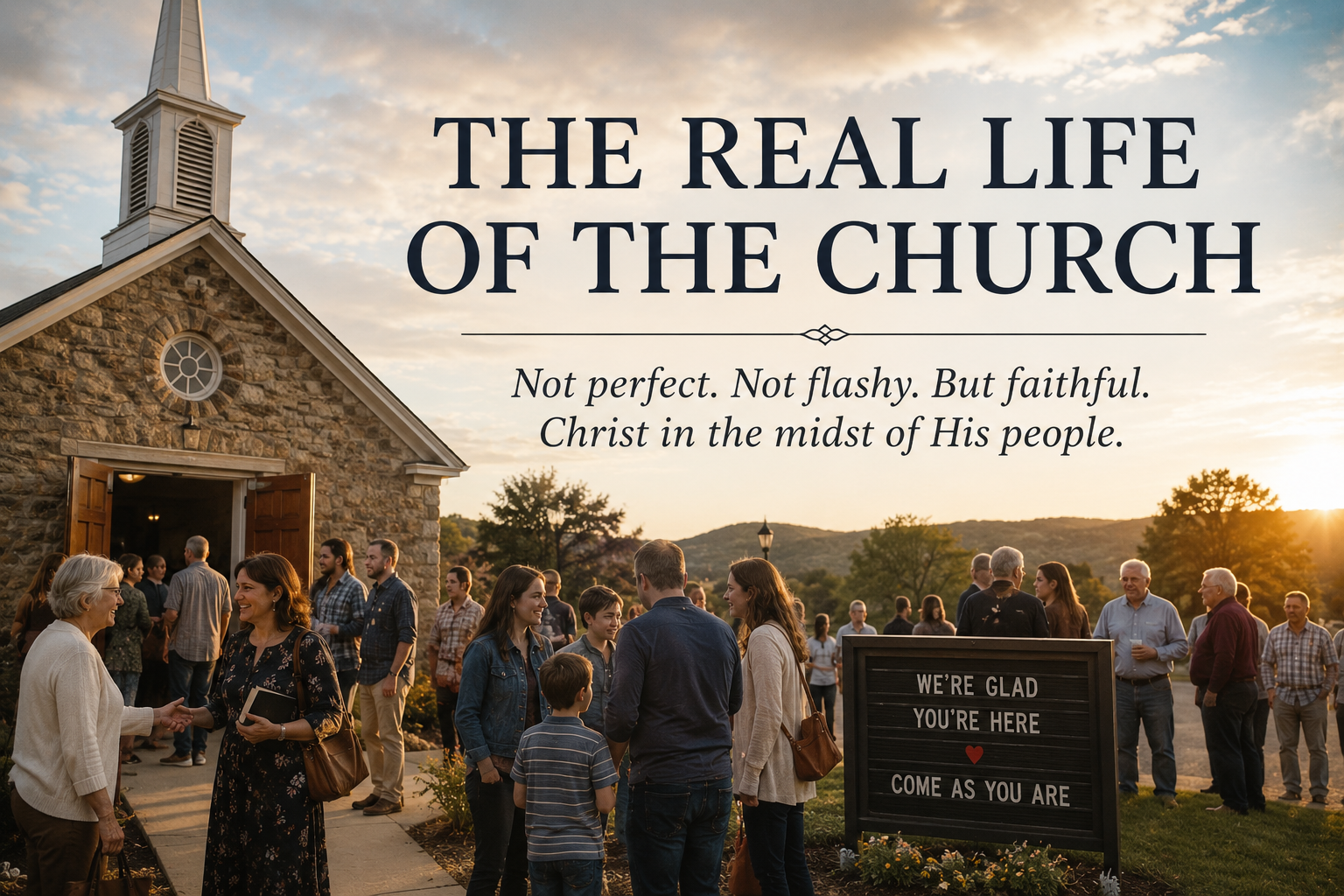
The Real Life of the Church
The real life of the church is usually less dramatic than people imagine. It is built quietly through ordinary faithfulness — shared meals, whispered prayers, hospital visits, imperfect people, long memories, and Christ remaining present among His people over time. The Real Life of the Church explores the beauty, humor, frustrations, and sacred endurance of ordinary congregational life and why imperfect churches still remain one of God’s primary instruments for forming disciples.
The real life of the church is usually less dramatic than people imagine.
Most churches are not built upon constant revival, endless momentum, fog machines, or pastors descending from the ceiling on harnesses while an electric guitar solo plays in the background. They are built much more quietly than that — through ordinary faithfulness repeated over long stretches of time.
Meals shared in fellowship halls.
Prayers whispered in hospital rooms.
Volunteers arriving early to unlock doors and make coffee.
Choir rehearsals.
Committee meetings that run too long.
Children growing into adults somewhere between the nursery and the youth room.
Elderly saints quietly occupying the same pew for forty years like unofficial guardians of sacred territory.
This is the real life of the church.
From a distance, people often imagine church life in extremes.
Some romanticize it into a kind of permanent spiritual mountaintop where everyone smiles constantly, agrees naturally, and experiences uninterrupted victory. Others become cynical and reduce the church to little more than politics, bureaucracy, personality conflicts, and institutional frustration.
The truth is less glamorous and far more beautiful.
The local church is neither a flawless spiritual utopia nor merely a struggling organization held together by budgets and casseroles. It is a living body made up of redeemed but unfinished people attempting to follow Christ together across long stretches of ordinary life.
And that means things can become messy.
People occasionally misunderstand one another.
Pastors say things imperfectly.
Committees drift into anxiety.
Members become frustrated.
Someone gets their feelings hurt over a decision about carpet color that somehow escalates into a theological crisis involving three generations and a side dish at the church potluck.
Church life has always contained a certain amount of humanity.
The Apostle Paul spent much of the New Testament lovingly correcting churches that were confused, divided, immature, distracted, prideful, fearful, or occasionally behaving in ways that would make modern church consultants break out in stress hives. Yet remarkably, Paul still referred to these imperfect gatherings as the body of Christ.
That should encourage all of us.
One of the great mistakes of modern church culture is assuming that difficulty automatically means failure. In reality, long-term Christian community inevitably involves friction because spiritual formation happens among real human beings, not idealized religious avatars. Churches are filled with people carrying wounds, histories, fears, habits, personalities, political opinions, grief, insecurities, and unfinished sanctification.
Including the pastor.
Especially the pastor, some days.
Yet somehow, through all of this, Christ continues to remain present among His people.
That may be one of the most miraculous realities in the entire Christian faith.
The holiness of the church is not found in the absence of weakness, but in Christ’s willingness to remain present among imperfect people.
Real church life unfolds slowly.
Very slowly sometimes.
Discipleship rarely looks as dramatic as people expect. Most spiritual growth does not happen during emotionally intense moments alone. It happens through repetition. Through worship services attended faithfully even during difficult seasons. Through learning forgiveness after conflict. Through sitting beside grieving families. Through raising children inside a community of faith. Through serving when tired. Through continuing to pray when emotions feel absent. Through hearing Scripture read week after week until its language slowly reshapes the soul.
The church forms people gradually.
That gradual formation can feel unimpressive in a culture addicted to immediacy. We prefer dramatic transformations, instant results, viral moments, and visible success. But God often seems remarkably comfortable working through slower processes than we would personally prefer.
The local church reflects this divine patience.
A faithful congregation learns one another over time. Shared memory develops. Trust deepens. Stories accumulate. Inside jokes emerge that newcomers will never fully understand no matter how many times someone explains what happened during the Christmas Eve candle incident of 1998.
This continuity matters more than modern culture often realizes.
The church is one of the few remaining places where multiple generations still attempt to live life together under a shared spiritual identity. In a healthy congregation, elderly saints, exhausted parents, recovering addicts, energetic children, grieving widows, skeptical visitors, lifelong believers, and spiritually curious newcomers all occupy the same sacred space together.
That is not accidental.
It is part of the wisdom of the church itself.
And yes, this kind of shared life can occasionally become frustrating. Sometimes deeply frustrating. There are seasons when pastors feel weary, members feel misunderstood, volunteers burn out, and everyone briefly considers whether Jesus might return before the finance committee reaches a decision.
Still, despite all its imperfections, the local church remains one of the most sacred places on earth.
Because here people are baptized.
Here Scripture is proclaimed.
Here communion is shared.
Here sins are confessed.
Here burdens are carried together.
Here children learn the name of Jesus.
Here grieving families are surrounded.
Here lonely people discover belonging.
Here marriages are strengthened.
Here aging saints finish their race.
Here ordinary believers slowly become more like Christ.
Not perfectly.
Not quickly.
But truly.
The real life of the church is often quieter than the world expects. It seldom looks impressive enough for headlines. It rarely feels efficient. It can even appear fragile at times.
But beneath all the imperfections, something holy is still taking place.
Christ is forming a people.
And remarkably, He has chosen to do much of that work through ordinary congregations filled with ordinary people learning to love Him — and one another — over time.
Authority That Stays
In a culture fascinated with visibility, charisma, and performance, many forms of leadership appear powerful but fade quickly. Lasting spiritual authority is formed differently — through prayer, endurance, humility, suffering, repentance, and long obedience over time. Authority That Stays explores the hidden interior life beneath faithful pastoral leadership and the kind of spiritual formation that allows shepherds to remain steady, tender, and grounded through the real pressures of ministry.
Some forms of authority are loud but temporary.
They depend upon momentum, charisma, novelty, fear, visibility, or emotional intensity. They can attract attention quickly and create the appearance of strength. But over time, many forms of externally driven authority begin to weaken because they are sustained primarily by personality, energy, or control.
Spiritual authority works differently.
The authority that truly endures is usually quieter. Slower. Less theatrical. It is formed gradually through integrity, consistency, suffering, prayer, repentance, faithfulness, and the long obedience of remaining present over time.
People eventually recognize the difference.
Not immediately.
Not perfectly.
But eventually.
They learn whether a pastor’s words arise from performance or conviction. Whether leadership flows from insecurity or inward steadiness. Whether correction emerges from irritation or genuine love. Whether the shepherd remains faithful when applause disappears.
Real spiritual authority cannot be manufactured through branding, position, or force of personality alone. It emerges from the hidden interior life of a leader shaped slowly by Christ.
This truth becomes increasingly important in an age fascinated with visibility. Modern leadership culture often rewards immediacy, reaction, platform growth, certainty, and presentation. Churches can quietly absorb these same instincts. Pastors may feel pressure to become endlessly impressive, emotionally compelling, strategically innovative, or publicly influential simply to maintain credibility.
But the deepest forms of pastoral authority rarely emerge from performance.
They emerge from endurance.
From remaining faithful through disappointment.
From learning humility through suffering.
From surviving criticism without becoming cynical.
From carrying responsibility without needing constant recognition.
From repenting honestly.
From remaining teachable.
From allowing the Holy Spirit to keep softening the heart instead of hardening it.
In many ways, authority is tested most clearly not during moments of strength, but during moments of limitation.
Anyone can appear confident when ministry is flourishing, attendance is growing, and encouragement is plentiful. The deeper question is what happens when leadership becomes costly. What happens when decisions are misunderstood, when criticism increases, when conflict emerges, or when visible results slow down? What happens when the pastor himself grows weary, uncertain, wounded, or spiritually dry?
These moments reveal whether authority rests primarily upon image or upon inward formation.
Pastors who build leadership primarily upon personality often become increasingly fragile over time. Every disagreement feels threatening. Every criticism feels deeply personal. Every challenge to authority becomes a battle for self-preservation. Control tightens because insecurity deepens.
But pastors whose identity is increasingly rooted in Christ often develop a different kind of steadiness.
Not passivity.
Not weakness.
Not indecisiveness.
Steadiness.
A growing ability to remain calm without becoming detached.
To listen without surrendering conviction.
To lead without theatricality.
To absorb tension without immediately retaliating.
To remain tender without becoming naïve.
This kind of authority is difficult to fake because it is not primarily a communication style. It is the outward expression of an inwardly formed life.
And formation always takes time.
It usually develops slowly through hidden disciplines and difficult seasons that few people ever fully see. Prayer reshapes motives. Repentance exposes pride. Suffering deepens compassion. Failure dismantles illusion. Loneliness reveals dependency upon God. Long-term shepherding teaches patience that quick success never could.
Ironically, some of the strongest pastoral leaders eventually speak more gently, not more aggressively. Their confidence no longer depends upon dominating rooms or winning every argument. They no longer need to prove authority constantly because they have become less anxious about protecting themselves.
The pastors most secure in authority are often the least obsessed with proving they possess it.
This does not mean conviction disappears. If anything, conviction often deepens. But it becomes less reactive and more settled. Leadership grows less performative and more pastoral.
The New Testament consistently points toward this kind of mature spiritual leadership. Shepherds are called not merely to teach sound doctrine, but to embody spiritual character. The qualifications for leadership in Scripture emphasize integrity, self-control, faithfulness, humility, gentleness, and endurance far more than charisma or public influence. The shepherd’s life itself becomes part of the message.
This is one reason spiritual formation matters so deeply for pastors.
Without inward formation, authority eventually becomes exhausting. Leaders begin carrying responsibilities their souls are no longer healthy enough to sustain. Ministry slowly shifts from overflow to survival. Fear, defensiveness, resentment, image management, or emotional fatigue quietly take root beneath outward functionality.
But when pastors remain rooted in prayer, repentance, Scripture, worship, friendship, accountability, and honest dependence upon Christ, something steadier begins to emerge. Leadership becomes less about protecting ego and more about serving faithfully. The pastor gradually learns that authority is not truly his to possess in the first place. It is something entrusted temporarily by God for the care of others.
That realization changes the soul.
It produces humility alongside courage.
Tenderness alongside conviction.
Patience alongside responsibility.
And perhaps most importantly, it allows authority to remain human.
The church does not need pastors who appear invulnerable.
It does not need carefully curated religious personalities who never struggle, never repent, and never admit weakness.
It needs shepherds whose lives are being steadily transformed by the same Christ they proclaim.
Because in the end, the authority that truly stays is not sustained by personality, position, or performance.
It is sustained by a life slowly surrendered to God over time.
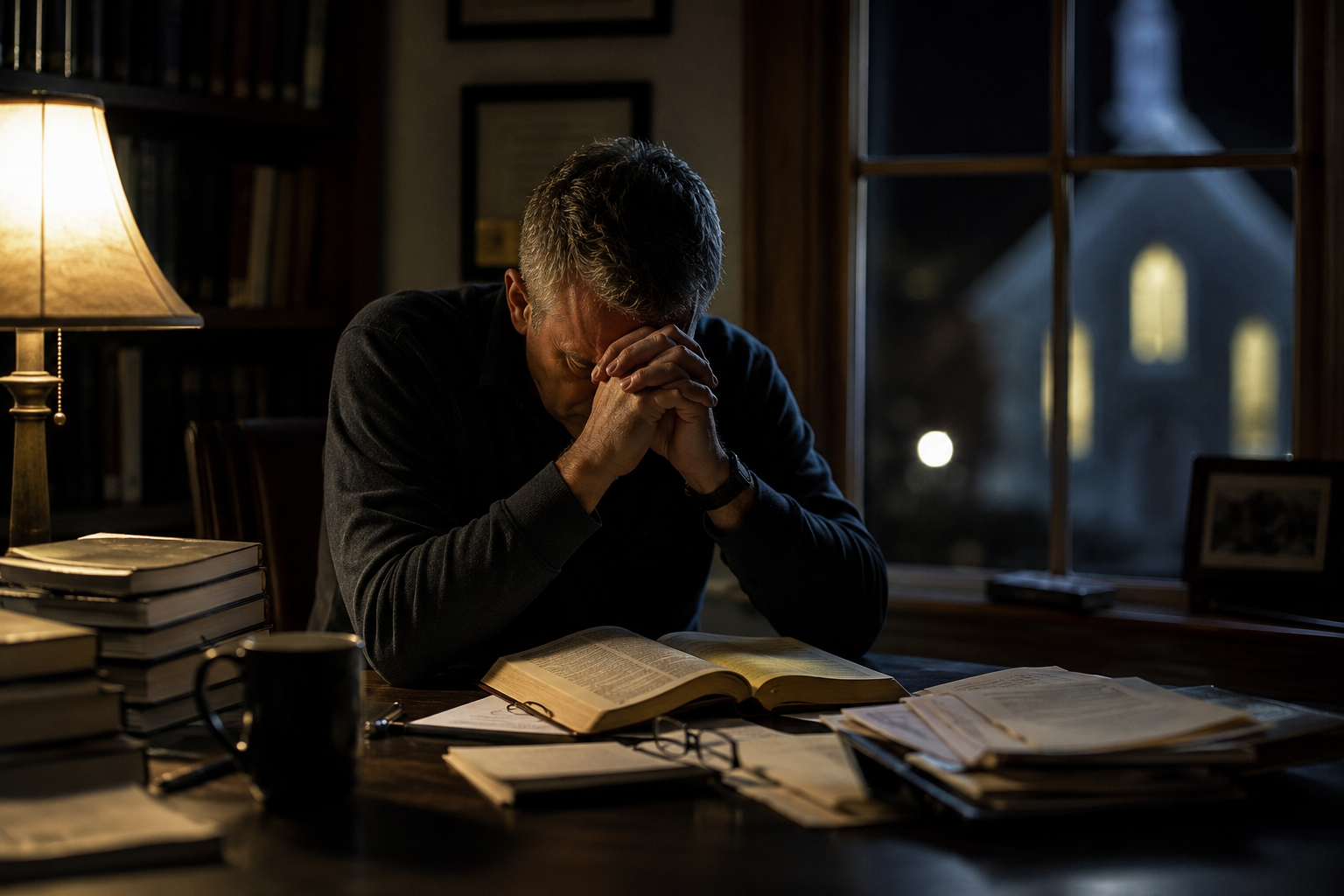
The Weight They Don’t See
Most people only encounter pastors in fragments — a sermon, a prayer, a hospital visit, a difficult conversation. What they rarely see is the accumulation: the quiet emotional, spiritual, and relational weight carried over years of shepherding. The Weight They Don’t See explores the hidden burdens of pastoral leadership, the exhaustion many faithful shepherds quietly endure, and why pastors need not only accountability, but also grace, encouragement, renewal, and understanding.
Most people only encounter pastors in fragments.
A sermon on Sunday morning.
A greeting in the hallway.
A hospital visit.
A prayer before surgery.
A funeral message.
A Bible study.
An email response.
A difficult meeting.
What they rarely see is the accumulation.
Pastoral ministry is not usually crushed by a single dramatic moment. More often, it is the steady layering of emotional, spiritual, relational, and institutional weight carried quietly over years. Some of that burden is holy and beautiful. Some of it is heartbreaking. Most of it remains invisible.
A pastor may stand calmly in a sanctuary while privately carrying the grief of a family in crisis, anxiety about a struggling staff member, concern for a drifting marriage, financial uncertainty within the church, lingering conflict between members, disappointment over criticism, and the spiritual heaviness of discerning what faithfulness requires next. By Monday morning, those burdens have not disappeared simply because the service ended well.
The congregation often sees the visible moments of ministry.
The pastor carries the accumulated ones.
This reality is difficult to explain because healthy pastors usually try very hard not to make themselves the center of attention. Much of shepherding involves absorbing tension quietly so that fear, confusion, and division do not spread unnecessarily through the congregation. In emotionally healthy churches, this often goes unnoticed because things simply appear stable. But stability itself usually rests upon someone carrying weight consistently over time.
That weight is not merely administrative.
It is emotional.
Spiritual.
Relational.
A pastor may walk into a leadership meeting already carrying knowledge that cannot yet be shared publicly. They may preach while grieving privately. They may sit with families whose lives are unraveling while simultaneously trying to protect the unity of an entire congregation. They may spend hours helping others process disappointment while having little safe space to process their own.
And unlike many professions, the work rarely remains at work.
Pastors carry people home with them.
Not physically, of course, but emotionally and spiritually. Faces linger in the mind during dinner. Difficult conversations replay late at night. Concerns emerge during prayer, while mowing grass, driving home, or lying awake at two in the morning. The shepherding role is difficult to compartmentalize because the work itself is deeply relational. A faithful pastor does not merely manage religious systems. He loves people. And love always carries vulnerability with it.
Over time, this accumulation can become exhausting in ways that are difficult to quantify.
Not because pastors work harder than everyone else.
Not because their suffering is greater than others.
But because they often live in the overlapping space between public leadership and private emotional burden-bearing.
Many pastors also carry the strange loneliness of necessary leadership.
Some decisions cannot be fully explained in the moment. Some situations require confidentiality. Some criticisms cannot be answered publicly without causing greater harm. At times, pastors absorb misunderstanding simply because protecting the church requires restraint. The congregation may only see the final decision. The pastor often carries the emotional and spiritual process behind it long before and long after everyone else moves on.
In today’s culture, this becomes even heavier.
We live in an age shaped by suspicion, reaction, and perpetual commentary. Social media has trained people to critique instantly and interpret motives confidently from a distance. Churches are not immune to this spirit. Pastors can find themselves navigating environments where leadership is simultaneously expected and distrusted. Every difficult decision risks disappointing someone. Every strong conviction risks being interpreted as control. Every attempt at spiritual guidance risks being filtered through the broader cultural collapse of trust in institutions and authority.
Over time, many pastors begin developing survival instincts.
Some become guarded.
Some become performative.
Some retreat into administration and avoid relational vulnerability altogether.
Others simply grow tired.
Very tired.
This exhaustion is not always dramatic. In fact, the most dangerous form is often slow and quiet. A gradual emotional numbing. A loss of joy. Sermons becoming functional instead of alive. Prayer becoming disciplined but no longer nourishing. The shepherd continues moving faithfully while internally running on diminishing reserves.
This is one reason pastoral renewal matters so deeply.
Not as indulgence.
Not as escape.
Not as professional self-care language detached from spiritual formation.
But because shepherds are human beings, not machines.
They require prayer, friendship, silence, honesty, rest, repentance, encouragement, and the renewing presence of God just like the people they serve. In many cases, they require it even more intentionally because they spend so much of their lives pouring outward.
The irony is that faithful pastors often hide their exhaustion best. They continue preaching. Continue visiting hospitals. Continue attending meetings. Continue caring for others. Continue showing up. Sometimes even they do not fully recognize how much weight they are carrying until the symptoms emerge through fatigue, discouragement, cynicism, anxiety, or spiritual dryness.
And yet, despite all this, many pastors continue serving with remarkable tenderness and endurance.
They continue praying over their people.
Continue preaching faithfully.
Continue grieving with the grieving.
Continue guiding churches through conflict and uncertainty.
Continue loving congregations imperfectly but sincerely.
That quiet endurance deserves understanding.
Not pedestal-building.
Not unquestioning loyalty.
Not the illusion that pastors are beyond accountability or weakness.
Simply understanding.
The church is healthiest when both pastors and congregations recognize that shepherding was never meant to be weightless. Scripture never portrays spiritual leadership as glamorous. It portrays it as sacrificial, relational, patient, and costly.
Which is why pastors do not merely need criticism when necessary.
They also need encouragement.
Prayer.
Grace.
Friendship.
And space to remain human.
Because sometimes the heaviest burdens in ministry are the ones nobody sees at all.
Bearing the Weight: Why Pastoral Authority Still Matters
In an age suspicious of authority, many pastors find themselves caught between passivity and performance — expected either to manage anxieties quietly or to lead through personality and spectacle. But the local church still needs shepherds: leaders willing to carry responsibility with humility, endurance, tenderness, and spiritual courage. Bearing the Weight explores why healthy pastoral authority still matters, what shepherds quietly carry, and why faithful leadership remains essential to the real life of the church.
There was a time when pastoral authority was largely assumed. Whether healthy or unhealthy, effective or ineffective, the role itself carried an understood weight within the life of the church. Pastors preached, guided, corrected, comforted, buried the dead, baptized the living, visited the sick, protected doctrine, and carried responsibility for the spiritual direction of congregations. Even disagreement with a pastor usually occurred within a shared understanding that leadership itself was necessary.
That world has changed.
We now live in an age suspicious of nearly every institution. Political scandals, corporate corruption, celebrity culture, spiritual abuse, denominational conflict, and the endless outrage cycle of social media have deeply eroded public trust. The modern person often approaches authority defensively before a single word is spoken. Churches have not escaped this reality. In many cases, they have amplified it.
Pastors today frequently find themselves trapped between two unhealthy expectations. On one side is the demand for endless accommodation, where leadership becomes little more than facilitating preferences, managing anxieties, and avoiding offense. On the other side is the temptation toward personality-driven leadership, where charisma, branding, performance, and influence replace patient shepherding. One creates passivity. The other creates spectacle. Neither resembles the slow, steady, burden-bearing work of a shepherd.
And yet, despite all of this, the local church still requires leadership.
Not domination.
Not celebrity.
Not control.
Shepherding.
The problem is that many people no longer know the difference.
Biblically speaking, authority was never meant to be self-exalting. Christ Himself described leadership in terms of servanthood, sacrifice, and responsibility. The shepherd imagery woven throughout Scripture is not glamorous. Shepherds guide, protect, search, warn, feed, endure weather, lose sleep, and remain with the flock long after applause disappears. Spiritual authority, rightly understood, is not the privilege of being obeyed. It is the burden of being accountable before God for the care of souls.
That burden is heavier than most people realize.
Pastors quietly carry funerals home with them. They absorb conflict while attempting to preserve unity. They sit with grieving families, anxious marriages, addicted individuals, wandering teenagers, exhausted caregivers, and lonely elderly saints. They make decisions knowing some people will inevitably misunderstand motives or resent outcomes. They pray through situations they cannot publicly explain. They preach while personally weary. They attempt to discern not only what is strategic, but what is faithful.
Many also carry the emotional residue of criticism in an age where criticism itself has become recreational. Congregational frustration, denominational instability, internet commentary, and cultural suspicion have created environments where many pastors learn to lead cautiously, speak cautiously, and sometimes retreat emotionally just to survive.
Some grow silent.
Some become defensive.
Some become managerial.
Some simply burn out.
And many churches unintentionally reinforce the problem by confusing spiritual maturity with perpetual consensus. But shepherding has never meant making everyone comfortable. Pastoral leadership sometimes requires difficult conversations, uncomfortable truths, patient correction, institutional restraint, or simply the willingness to stand steady when anxiety sweeps through a congregation.
This is especially difficult in modern church culture, where dramatic stories often receive more attention than quiet faithfulness. Revivalism, platform culture, and emotional immediacy can unintentionally create the impression that the ordinary life of the church is somehow inadequate. But most discipleship does not occur during dramatic moments. It occurs slowly — through worship, sacraments, Scripture, prayer, repentance, forgiveness, teaching, funerals, hospital visits, communion tables, shared suffering, and decades of ordinary presence.
The local church is not sustained by adrenaline.
It is sustained by endurance.
That endurance requires shepherds willing to bear weight over time.
As a Wesleyan pastor, I have come to believe more deeply than ever that healthy authority is inseparable from spiritual accountability and formation. The goal is never control. The goal is discipleship. Methodist tradition at its best has always understood that grace is not merely experienced in isolated emotional moments, but cultivated through practices, relationships, disciplines, community, and steady transformation over time. Pastoral leadership exists partly to help hold those rhythms together when the surrounding culture constantly pulls people toward distraction, fragmentation, and individualism.
Healthy pastoral authority is not about elevating pastors above the church. In fact, pastors themselves are deeply dependent upon the church’s prayers, encouragement, accountability, and grace. Shepherds are sheep too. But the office still matters. Responsibility still matters. Spiritual oversight still matters. The abandonment of authority does not create freedom. More often, it creates confusion, drift, exhaustion, and fragmentation.
The church does not need stronger personalities.
It does not need more religious performers.
It does not need leaders obsessed with image, influence, or control.
It needs steadier shepherds.
Shepherds willing to remain.
Willing to absorb weight without becoming hardened.
Willing to speak truth without losing tenderness.
Willing to guide patiently in anxious times.
Willing to endure long enough for real discipleship to occur.
In many ways, that is the heart behind everything I have written in the Bearing the Weight series. Not a defense of institutionalism. Not a plea for unchecked authority. But an appeal to recover a healthier, humbler, more durable vision of pastoral leadership rooted in Scripture, shaped by spiritual maturity, and sustained through the real life of the local church.
Because despite all our modern suspicion, confusion, and weariness, the people of God still need shepherds.
And faithful shepherding still matters.